
International Baccalaureate
The IB Diploma Programme (DP) a curriculum framework designed by the International Baccalaureate (IB) for students in the last two years of high school.
It is a two-year course that is academically challenging and balanced covering basic disciplines such as languages, arts, science, maths as well as providing opportunity for increased emphasis in selected subjects. It addresses the intellectual, social, emotional and physical well-being of students, and is respected by leading universities across the globe. It continues to be one of the most prestigious pre- university qualifications across the globe. IB students graduating with the IB diploma are able to study at universities all around the world, often with advanced credit.
Examinations are held at the end of Year 2, i.e. Grade 12.
The Diploma Programme is designed as a 'holistic programme that addresses the intellectual, emotional and physical well-being of students in Grades 11 & 12' and is receptive to the demands of a globally interconnected world which demands problem solving and analytical skills.
The DP is committed to the development of students according to the attributes shown in the IB learner profile. The IB learner profile describes the shared values that inform an IB education. The learner profile is a great summary of what the IB programmes want to achieve in terms of moulding the students into future leaders of the world.
Through the DP, schools are able to develop students who:
- have excellent breadth and depth of knowledge
- flourish physically, intellectually, emotionally and ethically
- study at least two languages
- excel in traditional academic subjects
- explore the nature of knowledge through the programme's unique theory of knowledge course.
Most successful Diploma Programme students lead very full lives. They are often members of athletic teams and involved in a wide range of activities. Time management and organization are key skills the IB develops in students.
International research shows that there are many benefits to choosing the DP over other 16-19 curricula. For example:
- DP students are better able than their peers to cope with demanding workloads, manage their time and meet the expectations placed on them, according to one study
- Analysis of DP students in Canada, the UK and the USA found that the DP's extended essay improves students' approach to learning in higher education
- 72% of students taking the DP in China attend one of the world's top 500 universities, according to a 2013 study.
Some key features of Diploma Programme assessment include the following.
- An emphasis on criterion-related (as opposed to norm-referenced) assessment
- This method of assessment judges students' work in relation to identified levels of attainment, rather than in relation to the work of other students.
- Valuing the most accurate demonstration of student performance, rather than just averaging attainment grades over a reporting period. IB Assessments deliver valid, fair and reliable results for students across the world.
The IBDP curriculum contains six subject groups together with a core made up of three separate parts as illustrated in the curriculum model below:
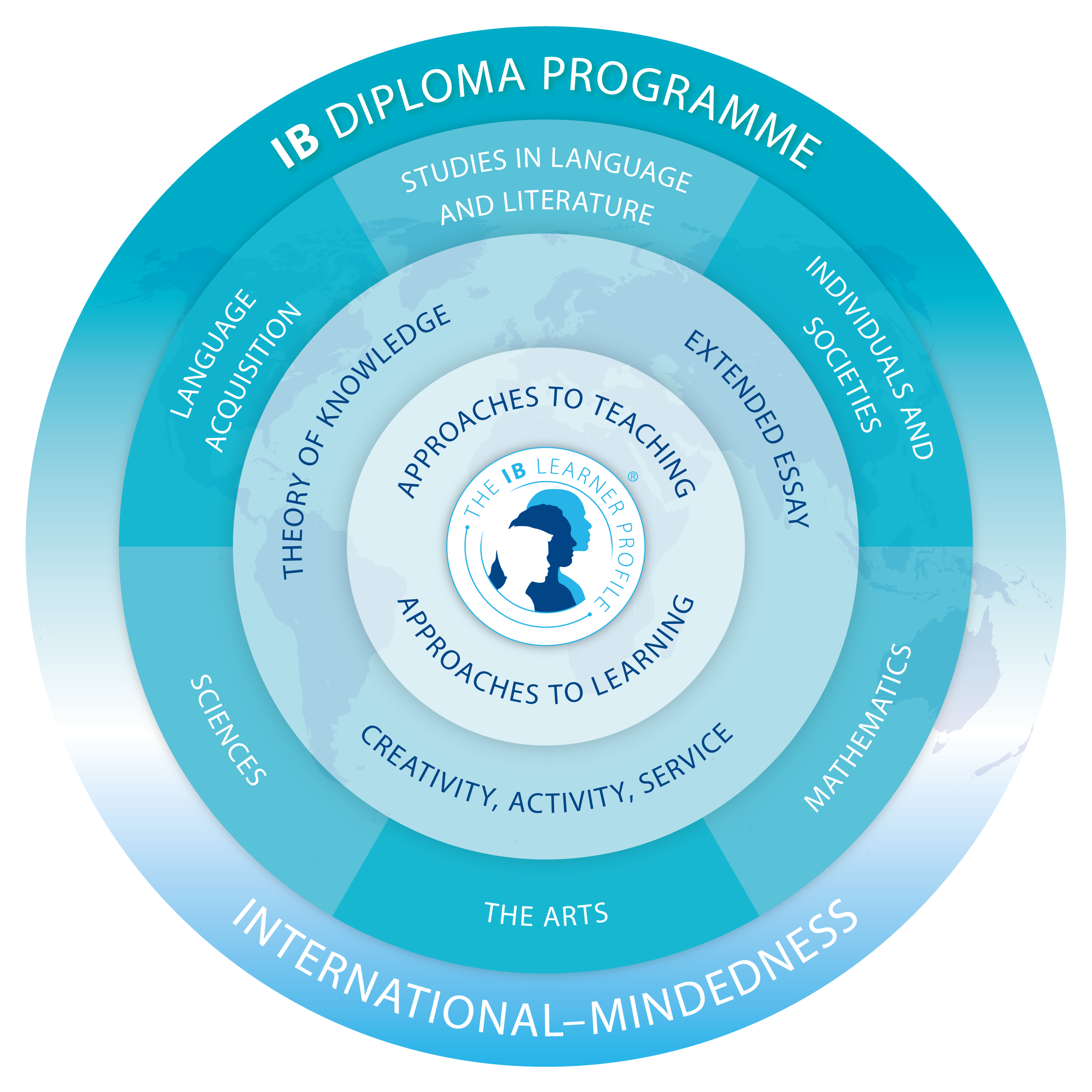
Students are expected to study three subjects at 'Higher Level' (HL) and three at 'Standard Level' (SL).
In addition to this, the three mandatory core components that contribute to a student's educational experience and challenge them to apply their knowledge and understanding are:
- The extended essay: The extended essay is a serious piece of academic research and writing wherein students independently research and investigate a topic of interest to produce a 4000-word in- depth study.
- Theory of knowledge (TOK) offers an opportunity for students to reflect on the nature of knowledge by critically examining how we know, through different ways of knowing and areas of knowledge. Students develop awareness of their own perspectives can act responsibly in an increasingly interrelated world.
- Creativity, activity, service (CAS) involves students in an array of different activities (such as community service work, sports, creative pursuits) alongside their academic studies thus fostering an appreciation of life beyond the classroom walls.
Through the Diploma Programme (DP) core, students reflect on the nature of knowledge, complete independent research and undertake a project that often involves community service.The Core ensures that the approach to learning is interdisciplinary, which allows our students to build skills that can help them engage with complex ideas and appreciate multiple perspectives.
Students need to select 6 subjects across the subject groups. (Or one subject from each of the 5 groups and the sixth subject can be from Group 3 or 4). Three subjects need to be at Higher Level (HL) and three subjects at Standard Level (SL).
HL / SL
SL
French B
SL
Hindi B
HL / SL
HL / SL
Economics
HL / SL
Psychology
HL / SL
HL / SL
Chemistry
HL / SL
Biology
HL / SL
Environmental Systems & Societies
HL / SL
Design Technology
HL / SL
HL / SL
Mathematics Analysis & Approaches
HL / SL
HL / SL
Digital Society
HL / SL
Environmental Systems & Societies
HL / SL
* These subjects will be offered depending on student interest and size of the cohort.
* To learn more about DP subjects, explore detailed information on each subject by clicking on the respective links.
- Experienced, internationally qualified and IB trained staff. Among our staff we have Examiners, Workshop Leaders and a motivated faculty who have an international outlook, with strong Indian values. All our DP teachers are highly trained professionals and subject experts in their fields and are also trained in the IB's approaches to teaching and approaches to learning.
- Our infrastructure includes world class laboratories (physics, chemistry, biology, design technology) and other facilities in order to enhance student learning at the high school level.
- A well-resourced library and media center to keep up with current developments in IB education.
- Ergonomic classrooms with state-of-the-art infrastructure.
- 45,000 Sq. ft. indoor sports complex.
- Nurturing, caring and safe environment.
- Conveniently located in Raipur.
- Being international-minded, global citizens who are inter-culturally aware, are the key traits that benefit the IB Diploma graduates in their university studies and career pursuits. Our College Counsellor guides and supports students in their university choices, based on their aptitude and aspirations.
- Our assessments use a variety of tasks, including examination papers, written assignments like essays, oral interviews, scientific and mathematical investigations, fieldwork projects and artistic works, which are completed by candidates at various times during their course.
- Our CAS programme, Theory of Knowledge (TOK) lessons and the Extended Essay process allows our students to showcase not only their knowledge but their gamut of 21st century skills they have developed as lifelong learners.
- Community service is an important component of our DP programme ensuring that the students reflect on their contextual learning and are motivated for self-initiated action for their community.
For more details about the IBDP programme, visit www.ibo.org
The Middle Years Programme (MYP) aims to assist students in developing their personal understanding, emerging sense of self, and community responsibility.
The MYP aims to develop active learners and internationally minded young people who can empathize with others and pursue lives of purpose and meaning.
The programme empowers students to inquire into a wide range of issues and ideas of significance locally, nationally and globally. The result is young people who are creative, critical, and reflective thinkers.
- Build confidence in managing their own learning
- Learn by doing, connecting the classroom to the larger world
- Outperform non-IB students in critical academic skills
- Consistently have greater success in IB Diploma Programme examinations
- Thrive in positive school cultures where they are engaged and motivated to excel
- Develop an understanding of global challenges and a commitment to act as responsible citizens
The MYP was revised in September 2014 to provide a more rigorous and highly flexible framework that powerfully integrates with local educational requirements. New industry-leading onscreen examinations and ePortfolios offer exciting opportunities for reliable, robust digital assessment of student achievement.
IB programme models highlight important shared features of an IB education:
- Developing the attributes of the learner profile
- Approaches to teaching and approaches to learning
- Age-appropriate culminating experiences
- An organized and aligned structure of subject groups or disciplines
- Development of international-mindedness as a primary aim and context for learning
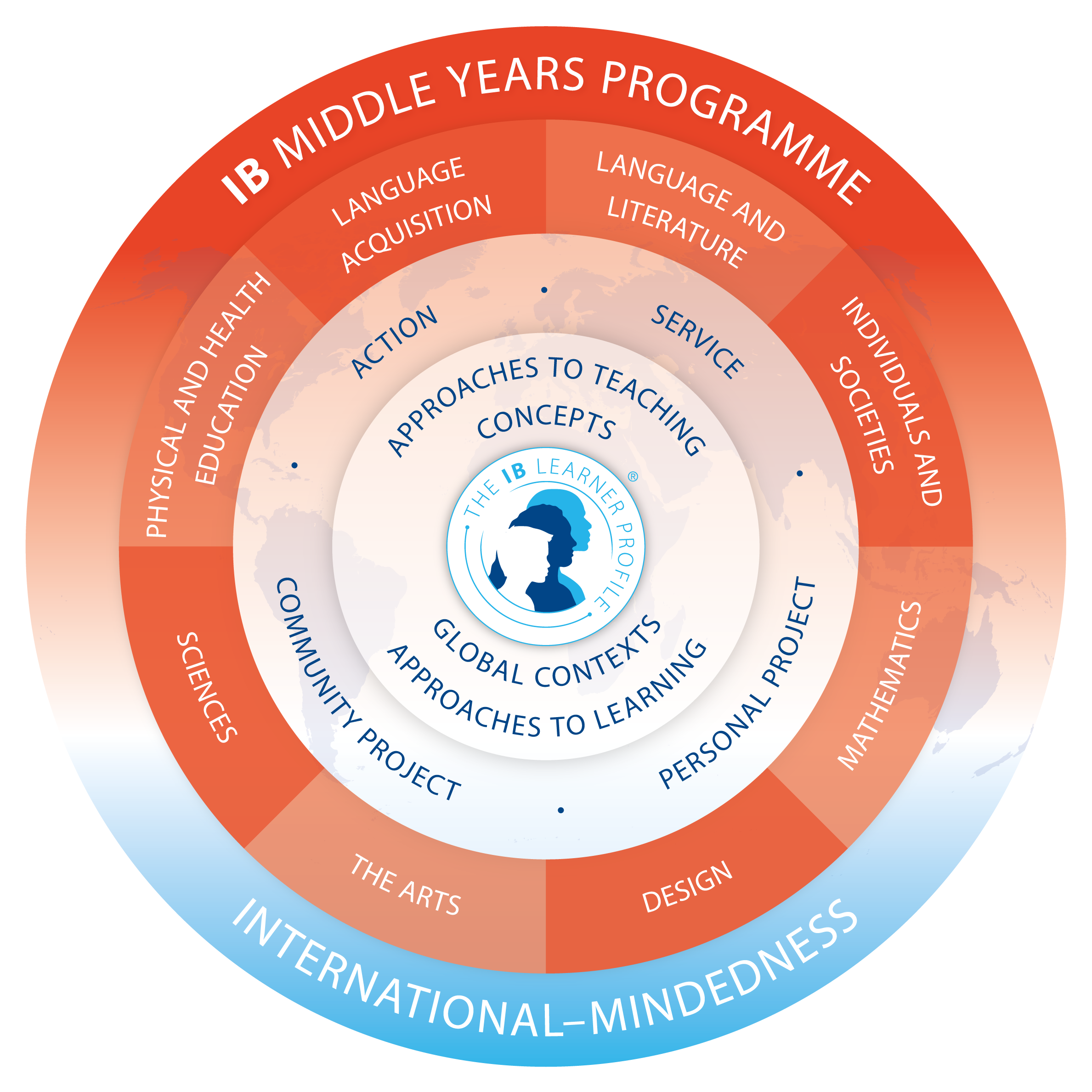
In the programme model for the MYP, the first ring around the student at the centre describes the features of the programme that help students develop disciplinary (and interdisciplinary) understanding:
- Approaches to learning (ATL): Demonstrating a commitment to approaches to learning as a key component of the MYP for developing skills for learning.
- Approaches to teaching: Emphasizing MYP pedagogy, including collaborative learning through inquiry.
- Concepts: Highlighting a concept-driven curriculum.
- Global contexts: Showing how learning best takes place in context.
The second ring describes some important outcomes of the programme:
- Inquiry-based learning may result in student-initiated action, which may involve service within the community.
- The MYP culminates in the personal project (for students in MYP year 5) or the community project (for students in MYP years 3 or 4).
The third ring describes the MYP's broad and balanced curriculum:
- The MYP organizes learning and teaching through eight subject groups: language and literature, language acquisition, individuals and societies, sciences, mathematics, arts, physical and health education, and design.
- In many cases, discrete or integrated disciplines may be delivered and assessed within a subject group: for example, history or geography within the individuals and societies subject group; biology, chemistry or physics within the sciences subject group.
- The distinction between subject groups blurs to indicate the interdisciplinary nature of the MYP. The subject groups are connected through global contexts and key concepts.
For further information about MYP subjects, check the following links:
- Language & Literature
- Language acquisition
- Individuals and societies
- Integrated Sciences
- Mathematics
- Arts
- Physical & Health Education
- Design
- Interdisciplinary learning
- Personal Project
The programme has been developed with developmentally appropriate attention to:
- Conceptual understanding
- Learning and teaching in context
- Approaches to learning (ATL)
- Service as action (community service)
- Language and identity
- Learning diversity and inclusion
For further information about the IB and its programmes, visit www.ibo.org
The following table outlines the subjects offered across all MYP year levels:
The PYP is a curriculum framework for young learners aged 3–12. Like all International Baccalaureate (IB) programmes, the IB learner profile permeates all facets of school life in the PYP.
The Primary Years Programme (PYP) is designed to be responsive to young children’s ways of knowing by the International Baccalaureate (IB), a not-for-profit organization supporting the education of more than 1 million students every year in over 3,900 schools in 147 countries. It provides schools with a thoughtfully designed way to give 3-to-5-year-olds stimulating, supportive interactions with their teachers and the effective use of curricula.
The PYP is based on the recognition of a child's natural curiosity, creativity and ability to reflect. It generates a stimulating, challenging learning environment to nurture the whole child and foster a lifelong love of learning for all. The PYP is transdisciplinary, meaning students learn across subject areas while inquiring into big ideas.
PYP students use their initiative to take responsibility and ownership of their learning. By learning through inquiry and reflecting on their own learning, PYP students develop knowledge, conceptual understandings, skills and the attributes of the IB learner profile to make a difference in their own lives, their communities and beyond.
The framework emphasizes the central principle of agency, which underpins the three pillars of school life:
- The learner
- Learning and teaching
- The learning community
- Acknowledges learner agency and the importance of self-efficacy to enable students to become partners in the learning process
- Addresses students’ academic, social and emotional well-being
- Encourages students to develop independence and to take responsibility for their own learning
- Supports students’ efforts to gain understanding of the world and to function comfortably within it
- Helps students establish personal values as a foundation upon which international mindedness will develop and flourish
- Provides the opportunity to learn more than one language from the age of seven
The PYP is organized around the six transdisciplinary themes. Transdisciplinary learning in the PYP conveys learning that has relevance between, across and beyond subjects and transcends borders, connecting to what is real in the world.
Through the six transdisciplinary themes, PYP students learn to appreciate knowledge, conceptual understandings, skills and personal attributes as a connected whole. They can reflect on the significance of their learning to take meaningful action in their community and beyond.
Through this process of learning in the PYP, students become competent learners, self-driven to have the cognitive, affective and social tools to engage in lifelong learning.
The image below represents the framework of the IB Primary Years Programme (PYP), a curriculum model used in International Baccalaureate (IB) schools for children aged 3–12. The diagram consists of multiple concentric circles, each highlighting key elements of the program.
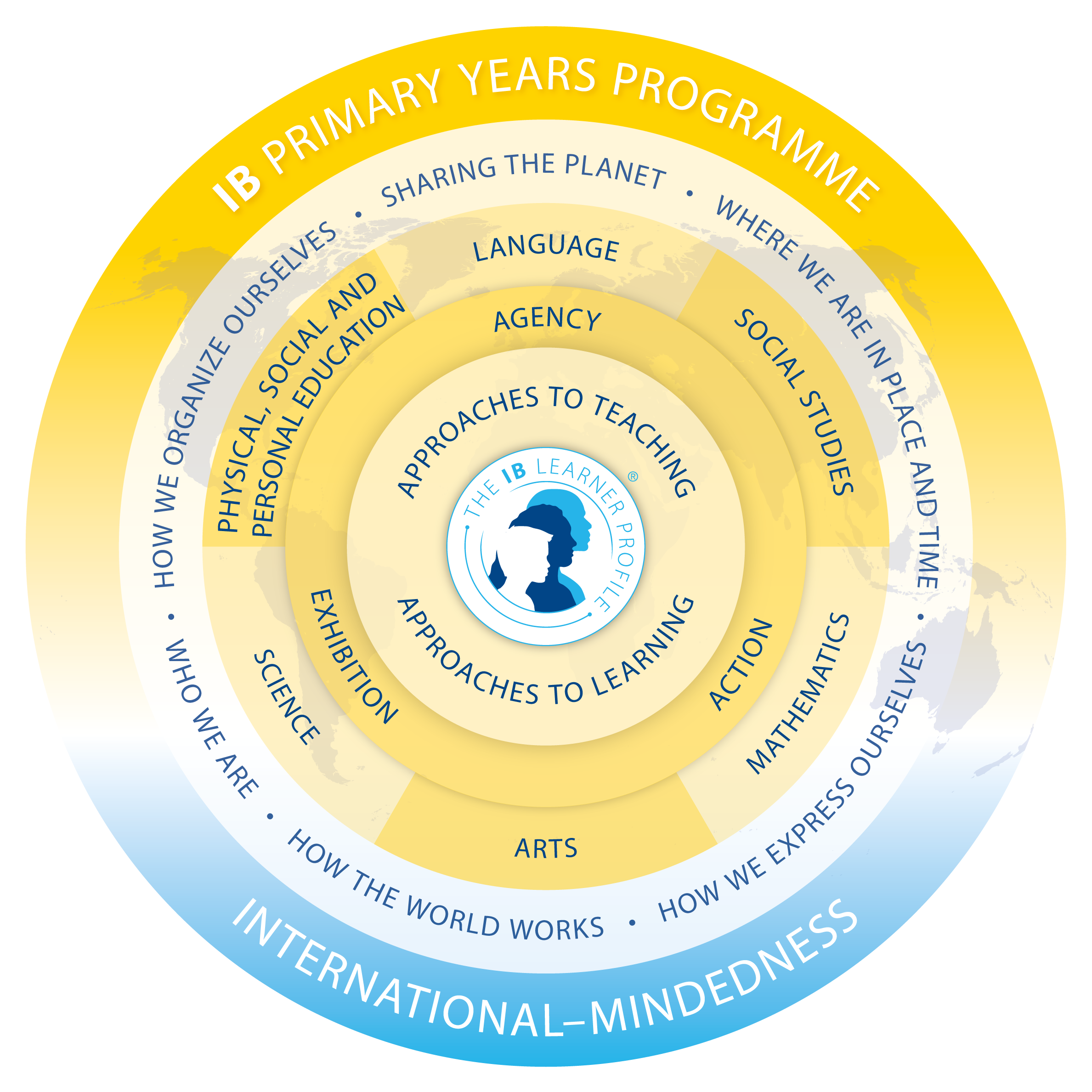
In the programme model for the PYP, the curriculum is visually and conceptually represented through concentric circles, each layer revealing a core aspect of IB philosophy and learning:
The Center Circle – IB Learner Profile
The core of the framework emphasizes the IB Learner Profile, which includes qualities such as being inquirers, thinkers, communicators, risk-takers, knowledgeable, principled, caring, open-minded, balanced, and reflective.
The Second Circle – Approaches
- Approaches to Learning: Skills that help students become self-regulated learners.
- Approaches to Teaching: Inquiry-based, concept-driven, and collaborative teaching methods.
- Agency: The active role of students in their learning process.
- Action: Encouraging students to take meaningful action based on their learning.
The Third Circle – Subject Areas
This layer includes traditional academic areas integrated into transdisciplinary inquiry:
- Language
- Social Studies
- Mathematics
- Arts
- Science
- Physical, Social, and Personal Education
The Outer Circle – Transdisciplinary Themes
These broad, globally significant themes guide curriculum connections across disciplines:
- Who We Are
- How We Express Ourselves
- How the World Works
- Where We Are in Place and Time
- How We Organize Ourselves
- Sharing the Planet
The Outermost Ring – International-Mindedness
The foundation of the IB philosophy, promoting global citizenship and intercultural understanding.
The PYP framework emphasizes inquiry-based, interdisciplinary learning that connects subject areas to real-world contexts, encouraging critical thinking and global awareness in students.
In the final year of the PYP, students take part in the PYP exhibition. The exhibition is an authentic process for students to explore, document, and share their understanding of an issue or opportunity of personal significance.
The whole learning community shares and celebrates this culminating event in the journey students have experienced through their PYP years.
- IB students develop a sense of the world around them and their responsibility to it. (See "What is an IB Education?")
- IB World Schools (the only schools authorized to offer IB programmes) are subject to a strict accreditation process monitored by the IB, ensuring that schools provide a high-quality education.
- IB approaches to learning and teaching are research-based and draw from the best educational practices from around the world.
- IB teachers are required to participate in many professional development opportunities to continually improve their awareness of current educational practices and new thinking by connecting with the global IB community.
- IB programmes are recognized internationally and ease the educational transitions of mobile students so that their education is not adversely affected if their families relocate.
For further information about the IB and its programmes, visit www.ibo.org